

Who goes there? Once the last light slips behind the garden fence, a homestead changes shifts. Deer test the orchard, raccoons investigate the compost, rodents inspect the feed shed, and a fox may stroll past the chicken coop as though it owns the deed.
Insects are notoriously difficult to photograph. They are small, fast, cold-blooded, and deeply uninterested in holding still while we fiddle with the focus. Most ordinary trail cameras use passive infrared sensors designed to notice larger, warm-bodied visitors. A 2024 insect-monitoring study describes those sensors as poorly suited to small, fast-moving ectotherms and explores a purpose-built visual trigger instead. None of the five cameras below promises macro focus, so a beetle appearance should be treated as a delightful cameo rather than the contract.
These cameras earn their place on Plan Bees by watching the larger web of life around a garden, apiary, orchard, compost pile, outbuilding, or chicken coop. They can help reveal who is browsing, digging, prowling, or passing through while the humans are indoors pretending the night shift has everything under control.
Can a trail camera help with homestead security?
Yes. A trail camera can add a quiet second set of eyes at a driveway, gate, barn, equipment shed, feed room, apiary entrance, or chicken coop. It can document unfamiliar vehicles, after-hours movement, and the four-legged opportunists who are technically trespassing but remain unimpressed by property law. Local SD-card recording also works beyond the reach of household Wi-Fi. Use it as an additional layer alongside sturdy locks, lighting, and a purpose-built security system where warranted.
Carol’s field note: My own Cabela’s trail camera currently lives in my office, and I love its gloriously uncomplicated arrangement: SD card in, switch on, done. For many homestead jobs, dependable local recording is more useful than another app clamoring for attention.
Quick answer
Choose a trail camera by deciding how you want to retrieve the evidence. Local-storage cameras keep things simple, short-range Wi-Fi lets you check images nearby without opening the camera, and cellular models can send photographs from more distant sites. For most gardens and outbuildings close to home, a short-range live-view camera offers the most useful balance of convenience and cost.
How we chose
We ranked these five editorial picks from #5 to #1 using their documented trigger speed, night vision, weather resistance, file-access method, included accessories, and usefulness around a working homestead. This is an assessment of supplied features and audience fit, not a claim about sales popularity or personal product testing.
Product details, availability, service requirements, and shipping restrictions can change. Confirm current contents, specifications, app compatibility, cellular coverage, and subscription costs with the retailer before purchase.
Reviewed by Carol Maier, B.Sc., professional entomologist and founder of the original Victoria Bug Zoo.
Affiliate disclosure: Clicking is free. If you make a purchase through one of these links, Bug Zoo® may earn a commission at no additional cost to you. As an Amazon Associate I earn from qualifying purchases.
#5: Adjustable 4K Trail Camera with Onboard Screen
Clicking is free. Bug Zoo® may earn a commission if you buy, at no additional cost to you.

This straightforward local-storage camera records up to 64MP still images and 4K video. Its 0.2-second trigger, 120-degree detection view, burst shooting, and no-glow infrared make it a practical set-it-and-return-later option. The two-inch color screen lets you preview the evening's suspects at the camera.
Why it stands out
- Adjustable photo settings and 4K video provide several recording choices.
- The built-in screen allows on-site previews without another device.
Good to know: It uses eight AA batteries. A memory card, rechargeable batteries, and compatible solar panel are sold separately according to the supplied information.
Best for: A nearby garden edge or outbuilding where simple local recording matters more than phone access.
#4: Solar-Ready 5K Trail Camera with Included Storage
Clicking is free. Bug Zoo® may earn a commission if you buy, at no additional cost to you.
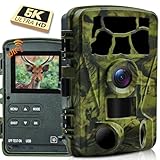
This rugged option lists 5K video with audio, 60MP still images, a 120-degree view, and low-light night vision reaching up to 65 feet. Its IP66 casing suits exposed outdoor locations, while the supplied package includes a 64GB memory card, carrying strap, and Type-C cable. The listing also describes a solar-panel design that requires no wiring.
Why it stands out
- The IP66 rating and solar-ready design are appealing for longer outdoor deployments.
- Included storage removes one small but irritating setup errand.
Good to know: The supplied specifications do not confirm close focusing or macro capability. Confirm exactly what the solar configuration includes before buying.
Best for: A weather-exposed garden, orchard, or apiary perimeter where ruggedness and reduced battery fuss are priorities.
#3: Cellular Trail Camera for Remote Sites
Clicking is free. Bug Zoo® may earn a commission if you buy, at no additional cost to you.

This 32MP cellular camera is designed to send photographs to a phone or desktop, saving a walk to a distant fence line every time something trips the sensor. It lists invisible infrared illumination, detection up to 80 feet, and trigger performance under 0.7 seconds. Its companion app can organize images by species, time, weather, and moon phase.
Why it stands out
- Cellular delivery makes sense for a remote gate, pasture edge, bee yard, or seasonal property.
- App filters can make a long monitoring project easier to review.
Good to know: The documented weather-resistance rating is IP54. Confirm cellular coverage, plan requirements, and recurring costs for the intended location.
Best for: A monitoring point far enough away that retrieving a memory card becomes a recurring pain in the ass.
#2: Complete 4K Wi-Fi Trail Camera Kit
Clicking is free. Bug Zoo® may earn a commission if you buy, at no additional cost to you.

This 4K and 48MP camera arrives with much of the scavenger hunt already completed. The supplied package lists a 32GB memory card, eight batteries, wall-mount bracket, USB cable, and strap. It adds a two-inch color screen, a 0.1-second trigger, a 120-degree detection angle, and an IP66 weather-resistant casing.
Why it stands out
- The included card, batteries, bracket, cable, and strap create the most complete starter package in the group.
- Both onboard viewing and short-range phone downloads provide flexible ways to retrieve files.
Good to know: Its built-in hotspot works at roughly 5 to 8 meters for setup and downloads. It does not connect to home Wi-Fi or provide true remote viewing.
Best for: Someone who wants a well-equipped first camera for the coop, compost area, feed shed, or garden boundary.
#1: Live-View Wi-Fi Trail Camera
Clicking is free. Bug Zoo® may earn a commission if you buy, at no additional cost to you.

Our #1 pick favors usefulness over a megapixel shouting contest. Its dedicated app, Bluetooth, and built-in Wi-Fi allow a compatible phone to connect from a stated distance of up to 45 feet in open conditions. Live View helps with framing and lets you check the scene from nearby without marching straight through it. The camera records 64MP photos and 1296P video, with no-glow infrared illumination listed up to 75 feet.
Why it wins
- Live View is genuinely useful when positioning the camera around a garden, coop, or other active homestead area.
- Direct phone access avoids both a monthly cellular service and repeated handling of the memory card.
Good to know: This is a direct short-range connection. It does not join a home router or cellular network, and computers and web browsers are not supported for its Wi-Fi connection.
Best for: Most homesteaders who want convenient nearby monitoring and easy camera placement without adding another subscription.
Final thoughts
The Live-View Wi-Fi Trail Camera takes our #1 spot for most homesteads because good positioning and convenient checking will usually matter more than the loudest resolution number on the box. Choose the complete 4K kit when you want batteries, storage, and mounting hardware together. The cellular camera earns its keep at a genuinely remote site, while the two local-storage choices suit anyone happy to collect the evidence in person.
Point one toward the garden, apiary perimeter, compost pile, feed shed, or chicken coop, and the night will begin leaving receipts. The insects may still refuse to pose. Frankly, that is part of their charm.
Frequently asked questions
Can an ordinary trail camera photograph insects?
It may capture a larger insect that happens to cross the frame, especially near a flower or light, but none of these five cameras confirms macro focus. Standard passive infrared triggers are also poorly suited to detecting small ectothermic animals. Use a macro camera, time-lapse setup, or purpose-built insect-monitoring system when insects are the primary subject.
What is the difference between Wi-Fi and cellular trail cameras?
The Wi-Fi models here create short-range direct connections for nearby setup, viewing, or downloads. A cellular camera can transmit images from farther away when the site has compatible coverage and service.
Where can a trail camera help around a homestead?
Useful locations include garden boundaries, orchard edges, apiary perimeters, compost areas, feed storage, gates, outbuildings, and chicken-coop approaches. Position the camera for the animal route and the distance its lens can actually focus.
Does the highest megapixel number guarantee the best result?
No. Trigger reliability, lens and focus performance, framing, night illumination, weather resistance, and convenient file access can matter just as much as the advertised resolution.
Thanks for supporting our mission to make the world a better place for everyone, bugs included.