

To water, or not to water? That is the question. Along with whether to open the greenhouse, cover the seedlings, or get the washing in before the rain. Shakespeare had his kingdoms. We have tomato patches, beehives, and a surprising number of decisions to make before breakfast.
A weather report for the nearest city can leave you wondering what is happening at home. Your own sensors put observations within reach: the temperature where you placed the outdoor sensor, the humidity in a monitored space, or, with the right equipment, the rain and wind on your property. There is something deeply satisfying about checking your own readings and getting on with the day.
These five weather stations and monitors offer different levels of detail. One measures wind and rainfall as well as temperature and humidity; the others concentrate on household and outdoor monitoring. The aim is useful, frequently refreshed information close to home, with technology earning its place among the homesteader's tools.
Quick answer
Start with the questions you want answered. A temperature monitor helps you check conditions at its sensor; multiple sensors let you compare locations. Humidity and pressure add detail, while wind and rainfall measurements give a fuller picture outdoors. Our countdown moves from a straightforward household display to our favorite for a homestead with gardens, beehives, and daily outdoor chores.
How we chose
We ranked these five options from our least favorite to our most favorite for local homestead monitoring, weighing the measurements provided, sensor flexibility, display features, alerts, and power requirements. The positions reflect our editorial preferences based on product information. We have not hands-on tested these stations. A lower-ranked option can still be the right fit for a simpler job.
Product details, availability, and shipping restrictions can change. Confirm current contents, specifications, and requirements with the retailer before purchase.
Reviewed by Carol Maier, B.Sc., professional entomologist and founder of the original Victoria Bug Zoo.
Affiliate disclosure: As an Amazon Associate I earn from qualifying purchases. This article contains affiliate links. Clicking these links is free. If you make a purchase through one of these links, Bug Zoo® may earn a commission at no additional cost to you. Thanks for supporting our mission to make the world a better place for everyone, bugs included.
#5: Large-Display Temperature Monitor
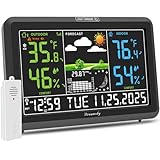
A large illuminated color display brings indoor and outdoor temperature, estimated forecasts, atomic time, and calendar details together in one place. The package includes one outdoor sensor and supports up to three. High and low temperature alerts, adjustable brightness, and battery backup make it a practical option for checking readings around the house.
Why it ranks #5
This is our fifth choice for homestead monitoring because its strongest features are the readable display, timekeeping, and temperature alerts. Three-sensor support is useful, but the other picks give us more of the environmental detail we would prioritize around the property.
- The display brings weather information, time and calendar details together in large numbers designed for viewing from afar.
- It supports up to three outdoor sensors and includes high and low temperature alerts for monitoring changes.
Good to know: The display is adapter-powered, and the backup battery is not included. On battery power alone, the screen lights for 10 seconds before dimming into power-saving mode.
Best for: readers who want an easy-to-read home display with multiple sensor support, temperature alerts and atomic time.
View on Amazon (affiliate link)
Clicking is free. Bug Zoo® may earn a commission if you buy, at no additional cost to you.
#4: Temperature and Humidity Alert Station

This station displays indoor and outdoor temperature and humidity, dew point, heat index, customizable high and low alerts, and daily records. Color comfort bars offer an at-a-glance view of humidity. Forecast icons, trend arrows, atomic time, and calendar functions share the screen, which stays lit on AC power with adjustable brightness.
Why it ranks #4
It moves ahead of #5 for its explicit high and low humidity alerts, dew point, heat index, and daily records. Those are useful checks around a home or workspace. It stays at #4 because the product information does not confirm support for multiple outdoor sensors, which limits its appeal for comparing separate locations.
- Custom alerts cover high and low temperature and humidity, while the display also shows dew point and heat index.
- Color comfort bars present indoor and outdoor humidity levels, with a listed range from 10% to 99% relative humidity.
Good to know: Allow the stated 7 to 10 days for barometric calibration of its forecast feature. Backup batteries for the display and the outdoor sensor are not included, and battery operation reduces backlighting.
Best for: homesteaders who want clear temperature and humidity alerts, comfort views and a continuously lit AC-powered display.
View on Amazon (affiliate link)
Clicking is free. Bug Zoo® may earn a commission if you buy, at no additional cost to you.
#3: Compact Multi-Sensor Weather Monitor
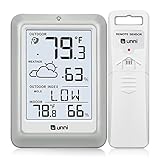
This compact monitor focuses on temperature and humidity, with heat index, dew point, and a mold index among its listed features. It supports up to three sensors and updates readings every 30 seconds, with a stated wireless range of up to 330 feet. Tabletop and wall-mounting options let you put the display where it is useful, and a button activates the backlight.
Why it ranks #3
This earns third place for its combination of up to three sensor channels, compact mounting options, and listed 30-second updates. That fits our interest in following conditions close to home. It offers less of the broad weather picture than the pressure display at #2 or the wind-and-rain station at #1.
- Its display includes heat index, dew point and mold index information in addition to temperature and humidity.
- The system supports up to three sensors and lists wireless transmission over a stated range of up to 330 feet with updates every 30 seconds.
Good to know: The package includes one outside sensor, and supported sensors should use different channels. Batteries are excluded from the package.
Best for: readers prioritizing temperature and humidity details, multiple monitoring points and a compact display with mounting flexibility.
View on Amazon (affiliate link)
Clicking is free. Bug Zoo® may earn a commission if you buy, at no additional cost to you.
#2: Multi-Sensor Weather Station with Pressure Display

This color-screen station brings together indoor and outdoor temperature and humidity, daily high and low records, customizable alerts, barometric pressure, forecast information, and moon phase. It supports up to three remote sensors, with one included. Adapter power keeps the display on continuously; battery operation uses an energy-saving mode.
Why it ranks #2
Our runner-up combines up to three remote sensors with temperature, humidity, pressure, daily records, and customizable alerts. That makes it a useful household hub for comparing locations. It falls short of first place because it does not measure wind or rainfall.
- The screen combines temperature, humidity, pressure, forecast information, alerts and daily high and low records.
- Up to three remote sensors can monitor indoor and outdoor locations, with one remote sensor included.
Good to know: Its estimated forecast covers the next 12 to 24 hours, with a stated 7 to 10 day calibration period. Batteries are not included.
Best for: homesteaders who want a detailed household display with pressure information, customizable alerts and several sensor channels.
View on Amazon (affiliate link)
Clicking is free. Bug Zoo® may earn a commission if you buy, at no additional cost to you.
#1: Wind and Rain Weather Station
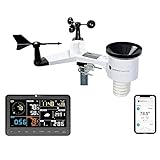
This station gives you the broadest outdoor picture in the group. Its sensor array measures wind speed and direction, temperature, humidity, rainfall, UV intensity, and solar radiation. A separate color display shows readings locally, while Wi-Fi supports remote viewing and alerts. Optional connections to compatible smart-home services and the manufacturer's weather network are available for readers who want them.
Why it wins
This is our favorite for the homestead because it measures wind speed and direction and actual rainfall, alongside temperature, humidity, UV, and solar radiation. That wider set of observations gives it a clear advantage for following outdoor conditions. Remote access is a useful extra, with network setup required for the connected features.
- Its sensor array includes wind, rainfall, UV intensity and solar radiation alongside temperature and humidity.
- Wi-Fi access supports remote data viewing, alerts and optional sharing through the manufacturer's weather network.
Good to know: Remote viewing and connected services require the appropriate network setup. Decide whether you want to check readings on the local display, access them online, or both.
Best for: homesteaders who want broad outdoor weather measurements, remote access and optional smart home connections.
View on Amazon (affiliate link)
Clicking is free. Bug Zoo® may earn a commission if you buy, at no additional cost to you.
Your Weather, Where You Live
The real appeal is being able to follow conditions at your own sensor locations throughout the day. Temperature changes, humidity readings, and high and low records can help you build a clearer picture of the spaces you actually use. Multiple sensor channels are useful if you want to compare locations, but extra sensors may need to be purchased separately.
Fresh readings are observations, not minute-by-minute forecasts. Update intervals vary by model. The compact monitor at #3 lists readings every 30 seconds; the other models should be checked individually if refresh speed is a deciding factor. Forecast icons on a household display are estimates, while a rain gauge measures rain that has reached it.
Give sensor placement the same attention you give the display. Follow the manufacturer's siting instructions so the readings represent the conditions you want to monitor. A sensor beside a sunny wall answers a different question from one positioned to measure shaded outdoor air. For wind and rainfall, the manufacturer's setup guidance for our #1 pick is a useful starting point.
You can check what is happening on your property without waiting for a weather segment or refreshing a news feed. Regional forecasts and severe-weather alerts still provide the wider view; your station adds the detail close to home.
Final Thoughts: Back to the Tomato Patch
Our #1 wind and rain weather station wins for the range of outdoor conditions it measures. If you want a household display with multiple sensor channels and pressure information, #2 is our runner-up. The compact #3 monitor suits frequent temperature and humidity checks; #4 prioritizes alerts, while #5 favors a large, readable display. Choose the level of detail that will earn its keep in your daily routine.
To weather or not to whether? A few useful readings can settle some of the morning's questions and get you back outside. If a bumblebee is already working the tomato blossoms, you have arrived in time for the day's live performance. Rimsky-Korsakov wrote Flight of the Bumblebee; your tomato patch supplies the soloist. Boots on. The good seats are in the garden.
Frequently asked questions
Which of these weather stations measures rainfall and wind?
The #1 wind and rain weather station is the only option here that lists wind speed, wind direction, and rainfall measurements. Its sensor array also measures temperature, humidity, UV intensity, and solar radiation.
Which models support more than one remote sensor?
The large-display monitor at #5, compact monitor at #3, and pressure-display station at #2 each support up to three sensors and include one in the listed package. The alert station at #4 lists one wireless outdoor sensor without confirming multi-sensor support.
What should I know about power and display operation?
The large-display monitor at #5 uses an adapter with battery backup. The pressure-display station at #2 offers a continuously lit adapter mode and an energy-saving battery mode. The alert station at #4 uses AC power for constant backlighting, with optional backup batteries. The compact monitor at #3 has a button-operated backlight that stays on for 10 seconds. Check the battery requirements and included accessories for your chosen package.