

A leaf, a beetle, a child with a question. Sometimes that is all it takes to open up an entirely new world. Add a closer look, and an ordinary afternoon can become a very busy investigation.
Tiny Critters, One BIG Idea
A note from Carol Maier, founder of the original Victoria Bug Zoo
When I started the Bug Zoo, I knew that I loved bugs and found them amazing. I still have vivid memories of those first encounters with the small world that inspired me. Tiny, tiny critters planted the seed of a very big idea.
What I had no idea of was just how fascinated children would be, or what a phenomenon the Bug Zoo would become. I knew how much these animals meant to me. Discovering how much they could mean to children was another kind of wonder.
That is part of what makes a closer look so exciting. You cannot know where a child's curiosity will lead. Mine led to a Bug Zoo.
A digital microscope gives children a screen on which to examine and share small discoveries. These five options differ in screen size, controls, accessories, storage, and carrying arrangements. The useful question is which one will help your child settle in, focus, and keep asking questions.
Quick Answer
For a first microscope, prioritize a clear screen, manageable controls, and a setup that is easy to steady. Prepared slides give beginners something ready to examine, a case keeps accessories together, and a larger screen makes sharing easier. Our countdown finishes with our favorite starter kit for its combination of learning materials and included storage.
How We Compared Them
We compared listed screens, controls, accessories, storage, battery information, and viewing arrangements. Our countdown runs from #5 to our favorite at #1, based on documented features and usefulness for beginning explorers. This is an editorial comparison, not a sales ranking or a report of hands-on testing. Magnification and camera figures below are advertised specifications, not independently measured performance.
Product details, availability, and shipping restrictions can change. Confirm current contents, specifications, and requirements with the retailer before purchase.
Reviewed by Carol Maier, B.Sc., professional entomologist and founder of the original Victoria Bug Zoo.
Affiliate disclosure: As an Amazon Associate I earn from qualifying purchases. This article contains affiliate links. Clicking these links is free. If you make a purchase through one of these links, Bug Zoo® may earn a commission at no additional cost to you. Thanks for supporting our mission to make the world a better place for everyone, bugs included.
A Little Science Before We Zoom In
Magnification makes something look bigger. Resolution determines how much detail you can distinguish. Enlarging a blurry image does not reveal new structures. Nikon's guide to useful magnification explains this as “empty magnification.” For a child's first viewer, a clear image, manageable focus, and steady support deserve more attention than the biggest advertised X number.
Try an insect detective challenge with an adult beetle or ant: can you find the head, thorax, and abdomen? Can you count six legs and locate the pair of antennae? Those are useful clues to insect identity. The Smithsonian's insect guide offers a simple introduction. Start by looking at the whole animal, then investigate a smaller detail if your viewer can bring it into focus.
#5: Pocket Microscope with Manual Focus
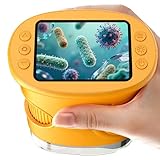
The pocket microscope with manual focus combines manual focus with a 2.0-inch IPS screen and a 2MP camera. Its listing advertises magnification up to 1000X, eight adjustable LEDs, and three brightness modes. A carry lanyard comes with the compact viewer. The listed 600mAh battery provides up to two hours of use, and USB export supports compatible Windows and Mac systems.
Why it stands out
- Manual focus gives children practice adjusting the image for themselves.
- Listed storage supports more than 200 photos; video recording and USB export offer additional ways to document observations.
Good to know: Allow for the listed maximum of two hours of battery use. Manual focusing takes practice, especially when a specimen or the viewer is moving.
Best for: Children ready to practice focusing and build a collection of nature photos and videos.
View on Amazon (affiliate link)
Clicking is free. Bug Zoo® may earn a commission if you buy, at no additional cost to you.
#4: Compact Handheld Digital Microscope

The compact handheld digital microscope puts a 2.0-inch IPS screen, photo and video functions, and adjustable lighting into a handheld viewer. Its listing advertises 200X to 1000X magnification and a 4K camera. Children can review and manage saved files, while a PC connection supports file transfer. A listed weight of 0.5 pounds and a neck strap make carrying it another practical consideration for outdoor outings.
Why it stands out
- Eight LEDs with three brightness levels offer control over lighting.
- Photo and video capture, a neck strap, and PC transfer support a portable discovery journal.
Good to know: The product information available for this comparison does not specify an included memory card or prepared slides. Confirm the package contents before ordering.
Best for: Explorers who prefer a compact viewer for leaves, fabric, coins, and gentle insect observation.
View on Amazon (affiliate link)
Clicking is free. Bug Zoo® may earn a commission if you buy, at no additional cost to you.
#3: Large-Screen Digital Microscope
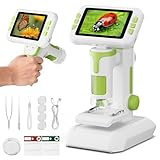
The large-screen digital microscope has the largest listed screen here at 4.0 inches, a useful feature when a child wants to show someone a discovery. Its detachable design offers desktop, handheld, and portable modes. The listing advertises 100X to 1600X magnification, a 1080P camera, and six LEDs with three brightness settings. Choose it for the screen and viewing setup rather than the highest number on the box.
Why it stands out
- The 4.0-inch screen offers more viewing space than the smaller screens listed on several other picks.
- Desktop and handheld options let families experiment with a steadier setup or portable viewing.
Good to know: The built-in lithium-polymer battery is listed as nonremovable. The advertised 1600X figure alone does not establish how much fine detail the viewer resolves.
Best for: Children who enjoy sharing a screen with an adult or sibling, with a desktop option for steadier viewing.
View on Amazon (affiliate link)
Clicking is free. Bug Zoo® may earn a commission if you buy, at no additional cost to you.
#2: Digital Microscope Kit with Carrying Case

The digital microscope kit with carrying case bundles a handheld viewer, prepared slides, and storage into a kit that can be packed away together. Its listed features include five magnification levels from 200X to 1000X, a focus wheel, LED lighting, and a 32GB memory card for photos and videos. A fitted EVA case holds the equipment, and the rechargeable battery is listed for approximately 2.5 hours of continuous use after a full charge.
Why it stands out
- Five real glass prepared slides introduce specimens that are ready to examine.
- A fitted case keeps the viewer, slides, cable, strap, and accessories together.
Good to know: The prepared slides are real glass, so adults should supervise handling. Plan around the listed 2.5-hour battery life on longer outings.
Best for: Families who value a carrying case and organized accessories for supervised science sessions.
View on Amazon (affiliate link)
Clicking is free. Bug Zoo® may earn a commission if you buy, at no additional cost to you.
#1: Digital Microscope Starter Kit with 12 Slides

The digital microscope starter kit with 12 slides pairs a 2.4-inch screen with photo and video capture in a portable viewer. The listing advertises 200X to 1000X magnification and a 4K camera. A neck strap, tripod hole, and PC connection give families several ways to carry it, steady it, and save what they find. The included slides offer something to investigate before heading outside.
Why it stands out
- A 32GB TF card, 12 prepared slides, slide-viewing cover, and silicone screen case are listed in the set.
- Eight LEDs and three brightness levels let children adjust illumination as they explore.
Good to know: The listing's age guidance varies. Match the controls and small accessories to the child's experience, and plan to explore together.
Best for: Families wanting a starter set with prepared slides, included storage, and several ways to record discoveries.
View on Amazon (affiliate link)
Clicking is free. Bug Zoo® may earn a commission if you buy, at no additional cost to you.
The Five-Minute Backyard Investigation
Start with a fallen leaf. Look at it without magnification and draw what you notice. Then steady the microscope, focus on one small area, and draw it again. Can you follow the branching veins? Does the edge look different up close? Turn the leaf over and compare its two surfaces.
Save a photo and add one observation and one question. “The underside looks different” is an observation. “Why?” is an excellent next step. Science has room for both careful notes and a delighted “Come and LOOK at this!”
For live insects, keep the encounter brief and gentle. Observe them on a leaf or another suitable surface, give them room to move, and return them where you found them. Never press a living insect between slides. A fallen leaf is a wonderfully cooperative first subject while everyone learns the controls.
Small Discoveries Can Grow
Our #1 pick is the digital microscope starter kit with 12 prepared slides, an included memory card, and a portable setup. The #2 kit adds a fitted carrying case for families who want to keep the pieces together. Choose #3 for its larger shared screen, #4 for compact carrying, or #5 for practicing manual focus and saving discoveries.
Whichever model makes your shortlist, give the child time to learn it with an easy subject and an interested adult nearby. A clear view of one leaf can be more rewarding than rushing through a dozen specimens.
The tiny critters that inspired my BIG idea were there long before I thought of opening a Bug Zoo. Looking closely was the beginning. Put a little world within a child's reach and see what questions follow. You may be shopping for a microscope, but the next big idea could already be out in the garden.
Frequently Asked Questions
Which has the largest screen?
The #3 large-screen microscope has the largest listed screen at 4.0 inches. The #1 starter kit lists 2.4 inches, while the #4 compact viewer and #5 manual-focus microscope list 2.0 inches.
Which kits include prepared slides?
The #1 starter kit lists 12 prepared slides, while the #2 carrying-case kit lists five real glass prepared slides. The product information used here does not confirm prepared slides for the other three options.
Can children save photos and videos?
All five list photo and video functions. The #1 and #2 kits list 32GB cards. The microscopes at #1, #4, and #5 list computer transfer or export features; confirm compatibility and included storage for the package you order.
Does 1600X mean a better image than 1000X?
That figure alone cannot tell you. Useful detail depends on the optics, focus, lighting, and imaging system. Compare actual sample images and ease of use along with the advertised magnification.