

Long before engineers programmed a robot, arthropods were already solving astonishing mechanical problems, and sometimes seemingly defying the laws of physics. Ants negotiate broken ground by continually adjusting six jointed legs through sensory feedback; beetles brace and push with muscles anchored to the inner surface of a load-bearing exoskeleton; cockroaches race over uneven terrain using an alternating tripod gait (and somehow do not trip over their own feet!); and spiders coordinate eight legs whose extension depends partly on hydraulic pressure. Nature has spent hundreds of millions of years refining the original walking machines.
That is why the wild world keeps showing up in robotics labs. The study of Biomechanics is learning how living bodies use structure, force, balance, and sensory information to move. Biomimetic engineering asks which of those principles can be translated into machines. An arthropod exoskeleton is not simply armor. Its hardened plates provide support and places for muscles to pull, while flexible membranes between jointed sections permit movement. Engineers may translate those ideas into segmented frames, compliant legs, low-mass structures, distributed sensing, and control systems that react quickly to the ground beneath them.
The five kits that we reviewed give a father and son, a classroom, or a curious young builder practical ways to explore the same big questions: How does a machine sense an obstacle? How do joints, wheels, motors, and code work together? What can engineers learn by watching an animal move?
With school season stirring up fresh curiosity, we are counting down from a capable starting point at #5 to our favorite at #1. The final pick brings nature, movement, color, and screen-free coding together in one wonderfully unusual creature.
Quick answer
Our top robotics kit for curious kids is the screen-free color-sensing robotic chameleon. It turns movement and physical coding cards into a memorable nature-inspired activity. The quick-build beginner robot is our strongest first robot car, the camera-equipped car adds richer sensor experiments, the Mecanum-wheel robot offers unusual multidirectional movement, and the circuit-building starter kit is best for learners who want to understand the electronics beneath a robot's shell.
How we chose
We compared the supplied kits by coding method, age guidance, assembly needs, sensors, movement, control options, included learning resources, battery requirements, and room for future projects. We also considered whether each kit gives children a clear way to connect code with a visible physical result.
Product details, availability, and shipping restrictions can change. Confirm current contents, specifications, and requirements with the retailer before purchase.
Reviewed by Carol Maier, B.Sc., professional entomologist and founder of the original Victoria Bug Zoo.
Affiliate disclosure: As an Amazon Associate I earn from qualifying purchases. This article contains affiliate links. If you make a purchase through one of these links, Bug Zoo® may earn a commission at no additional cost to you.
From cockroach legs to RoboBees: a short history
Bio-inspired robotics did not begin with a toy kit. In 1989, MIT roboticist Rodney Brooks published work on Genghis, a six-legged walking machine controlled by a network of small, decentralized behaviors. Instead of depending on one elaborate internal map, its control layers connected sensing more directly to action. In his 1990 paper Elephants Don't Play Chess, Brooks captured the philosophy in seven famous words: “The world is its own best model.”
That shift mattered. Insects do not pause to calculate a perfect mathematical copy of every stone before taking the next step. Their nervous systems, body mechanics, senses, and surroundings work together. In 1999, University of California, Berkeley biologist Robert J. Full and University of Michigan roboticist Daniel E. Koditschek formalized a powerful bridge between biology and engineering in Templates and Anchors. Their framework used simple models, called templates, to describe the shared dynamics hidden inside much more complicated bodies with many muscles, joints, and legs.
In 2001, Uluç Saranli, Martin Buehler, Koditschek, Full, and their colleagues reported RHex, a biologically inspired six-legged runner. It used six hip motors, compliant curved legs, and an alternating tripod gait, the stable three-legs-down pattern familiar from cockroach locomotion. RHex could move across rough terrain at better than one body length per second without trying to reproduce every anatomical detail of an insect.
The machines became lighter and faster. In 2009, Paul Birkmeyer, Kevin Peterson, and Ronald Fearing introduced DASH, a 16-gram, six-legged robot with a sprawled posture, compliant structure, and alternating tripod gait. It reached about 15 body lengths per second. Then, in 2013, Kevin Ma, Pakpong Chirarattananon, Sawyer Fuller, and Robert Wood reported controlled flight in an 80-milligram insect-scale robot modeled loosely on fly morphology. Its piezoelectric “flight muscles” powered flapping wings in a machine better known as RoboBee.
None of these robots is a mechanical copy of an insect. That is the interesting part. Engineers borrow principles such as compliant limbs, alternating gaits, lightweight structures, rapid sensor-to-action loops, and the ability to let body mechanics share the work of control. Arthropods are not blueprints. They are brilliant teachers.
What does an exoskeleton teach a robot designer?
In an arthropod, the skeleton is on the outside. Hardened sections of cuticle, often called plates or sclerites, resist loads and help protect the body. Muscles attach to the inside of that body wall and pull across articulated joints. Flexible membranes between harder sections preserve mobility. The result is not a rigid suit of armor, but a carefully organized compromise between protection, support, flexibility, and low mass.
A robot car avoiding a chair leg is not behaving exactly like an ant navigating a twig. Still, the experiment opens the same design conversation. A sensor detects a change, a controller interprets it, and a motor alters movement. Add compliant parts that bend, a body that absorbs an impact, or several limbs that share the load, and the relationship between biomechanics and robotics becomes even clearer.
#5: Circuit-Building Electronics Starter Kit

This kit begins beneath the robot's outer shell, with the circuits and components that make movement and sensing possible. It includes an Arduino-compatible board, LEDs, sensors, servos, resistors, jumper wires, and other pieces for electronics and coding projects.
Lifetime access to video lessons adds structure through lectures, labs, projects, problem sets, and coding examples. It is less instantly creature-like than the finished robots in this countdown, but it can help a motivated beginner understand what is happening when a sensor detects something or a servo moves.
Why it stands out
- The component-based format supports experiments with circuits, sensors, LEDs, servos, and microcontroller programming.
- Video lessons provide a guided route through the fundamentals instead of leaving beginners alone with a box of mysterious parts.
Good to know: This is an electronics and coding starter kit rather than a complete robot. The supplied information does not describe an insect-shaped build.
Best for: Students, educators, and hobbyists who want to understand the building blocks behind robotics.
#4: Sideways-Moving Mecanum-Wheel Robot
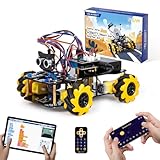
This programmable kit uses an ESP32 controller and four Mecanum wheels to move sideways, diagonally, forward, backward, and in rotation. That unusual freedom gives young builders plenty of room to experiment with navigation and obstacle challenges.
Story-based tutorials, illustrated instructions, and videos support a father-and-son build. Once assembled, the robot can be controlled through a smartphone app or an infrared remote and programmed with Arduino or Scratch-compatible tools. Separately sold expansions can add a camera, robotic arm, tank track, or solar panel.
Why it stands out
- Mecanum wheels create sideways, diagonal, rotating, and drifting movements that ordinary wheels cannot reproduce as easily.
- App control, remote control, Arduino compatibility, and Scratch compatibility give builders several ways to progress.
Good to know: Batteries are not included. The camera, robotic arm, tank track, and solar panel expansions mentioned in the supplied information are sold separately.
Best for: Families who want a flexible robot platform with distinctive movement and optional room to expand.
#3: Camera-Equipped Sensor Robot Car

This programmable vehicle combines a camera, line-tracking sensor, ultrasonic sensor, motors, and rechargeable battery. Children can assemble the chassis, connect the modules, begin with example programs, and then modify routes or reactions in the Arduino development environment.
App and infrared remote control make the finished car approachable before a child is ready to rewrite its behavior. Live first-person video, obstacle avoidance, and line following create visible experiments in sensing and response, the territory where robotics and biomechanics begin exchanging interesting ideas.
Why it stands out
- The camera and wireless module support live video alongside line tracking and obstacle avoidance.
- Keyed connectors, an illustrated tutorial, and example programs support a guided first build.
Good to know: The supplied specifications recommend the kit for ages 8 and up, with adult guidance for first-time builders.
Best for: Families, coding clubs, and classrooms looking for a sensor-rich robot car with a rechargeable battery.
#2: Quick-Build Beginner Coding Robot

This compact robot is designed as a friendly first step into electronics, robotics, and programming. Its instructions describe a build that can be completed in about 15 minutes, and the finished machine works as a remote-control car with line following and obstacle avoidance.
Coding cards, lessons, three included apps, and block-based software support a progression from simply driving the robot to programming games and working with Scratch or Arduino. The open system can also connect with a large range of electronic modules and compatible brick-building parts.
Why it stands out
- The quick build and clear instructions make the first success feel attainable.
- Guided coding resources provide a path from remote-control play to more deliberate programming.
Good to know: The robot requires four AA batteries, and the remote requires a CR2025 battery. The supplied record says these batteries are not included.
Best for: Children ages 8 to 12 who want a straightforward first coding robot with room for future projects.
Cue the tiny mechanical fanfare. Our top pick is the one that makes the conversation between biology and engineering impossible to miss.
#1: Screen-Free Color-Sensing Robotic Chameleon

This 15-inch robotic chameleon turns coding into a creature with articulated eyes, torso, and leg joints. A color sensor, infrared sensor, and RGB lights give children immediate visual feedback as they experiment with movement and response.
Physical colored action cards let children program the chameleon without a screen. Wild Mode explores color matching, while Pet Mode adds touch-responsive play. The guide also connects the project to the ways nature can inspire engineering design. A chameleon is a vertebrate, not an arthropod, but its shifting color, coordinated movement, and sensory responses make biomechanics wonderfully visible.
Why it takes our top spot
- Screen-free coding cards turn abstract instructions into physical actions children can arrange and test.
- Three modes combine programmed movement, color matching, and touch-responsive play.
- The nature-inspired design gives families an inviting way to discuss how living systems influence technology.
Good to know: The supplied guide lists assembly for ages 8 and up with adult help, while independent play is listed for ages 12 and up.
Best for: Curious young builders who want coding, movement, color, and biology to meet in one memorable project.
Final thoughts
The screen-free color-sensing robotic chameleon is our best overall pick because it makes coding physical and visibly connected to the living world. Choose the quick-build robot for the clearest first robot car, the camera-equipped car for richer sensor experiments, the Mecanum-wheel robot for multidirectional movement, or the circuit-building kit for a deeper start with electronics and components.
The best back-to-school projects do more than occupy an afternoon. They give a child a new question to carry into the classroom, the backyard, and the next build. Once a young engineer starts noticing the mechanics inside an ant's stride, a cockroach's tripod gait, or a beetle's jointed leg, the wild world becomes one enormous design laboratory.
Frequently asked questions
What is biomechanics in robotics?
Biomechanics studies how living bodies use structures, forces, and sensory information to move. Bio-inspired robotics can translate those principles into frames, compliant parts, motors, sensors, and control systems. Engineers study animals, including arthropods, for ideas about balance, locomotion, gripping, protection, and navigation.
How have arthropods inspired robots?
Arthropods have inspired engineers through their jointed limbs, lightweight exoskeletons, compliant body structures, sensory systems, and stable many-legged gaits. Six-legged robots such as Genghis, RHex, and DASH explored different ways to turn those biological principles into rugged movement, while RoboBee explored insect-scale flapping flight.
Which coding robotics kit is best for beginners?
The quick-build beginner coding robot is our strongest first robot car in this roundup because it offers a relatively fast guided build, remote-control play, coding resources, line following, and obstacle avoidance. Adult help may still make the first build smoother.
Which robotics kit offers screen-free coding?
The color-sensing robotic chameleon uses physical action cards, a color sensor, an infrared sensor, and RGB lights. Its coding activities do not require a screen, device, or software.
What age are these robotics kits for?
Several of the supplied kits are intended for children around age 8 and older, but assembly difficulty and the amount of adult help vary. The robotic chameleon lists assembly for ages 8 and up with adult help and independent play for ages 12 and up. The quick-build robot is listed for ages 8 to 12, while the camera-equipped car recommends ages 8 and up with adult guidance for first-time builders.
Are these robots directly modeled on insects?
Not all of them. The kits explore robotics concepts such as sensing, movement, control, and coding, while this article uses arthropod biomechanics to connect those engineering questions with nature. The robotic chameleon is the most visibly nature-inspired product in the group, although a chameleon is a vertebrate rather than an arthropod.
Thanks for supporting our mission to make the world a better place for everyone, bugs included.