
The insects already have the optical advantage. A dragonfly surveys the garden with thousands of tiny lenses in two enormous compound eyes. A butterfly sees the backyard in ways we can barely imagine. The rest of us get binoculars, which is honestly not a bad consolation prize.
Grab a pair and head outside. The yard is buzzing, fluttering, crawling, and occasionally doing something so gloriously weird that every child in the vicinity needs to see it immediately. These five binoculars count down from a family-sharing pair to our favorite child-sized field binoculars for following butterflies, dragonflies, birds, squirrels, and whatever just moved behind the raspberry canes.
There is still time for one more backyard safari before summer slips away and school begins. Better yet, a good pair of binoculars can keep the adventure going on fall walks, camping trips, school nature outings, and crisp afternoons when the insects are making the most of the remaining warmth.
Quick answer
The Tasco 8x21 kids’ binoculars are our best overall pick because their quick focusing, large field of view, fully coated lenses, protective rubber, and broad listed age range make them the strongest all-around field option. Choose the wooden beginner nature set for younger children who would enjoy a magnifying glass and identification cards, or the 10x25 family pair when adults and older children need one compact pair to share.
Important: Never allow a child to look at the sun through binoculars.
A quick compound-eye detour
An insect’s compound eye is made of many repeating visual units called ommatidia. Each samples a small part of the scene, and the nervous system combines that information into a useful view of the world. Compound eyes are especially good at detecting movement, which helps explain why a fly can react before the swatter has finished announcing its arrival.
Binoculars work very differently, but they give young humans their own optical advantage. The real magic begins when a child stops merely looking and starts noticing.
How we chose
We compared the five supplied options by age guidance, magnification, child-friendly handling, focusing features, field of view, protective construction, included learning materials, portability, and suitability for either individual or shared family use. Our assessment is based on the supplied product information and professional editorial review, not personal product testing.
Product details, availability, and shipping restrictions can change. Confirm current contents, specifications, age guidance, and requirements with the retailer before purchase.
Reviewed by Carol Maier, B.Sc., professional entomologist and founder of the original Victoria Bug Zoo.
Affiliate disclosure: As an Amazon Associate I earn from qualifying purchases. This article contains affiliate links. If you make a purchase through one of these links, Bug Zoo® may earn a commission at no additional cost to you.
#5: The Family-Share 10x25 Compact Binoculars
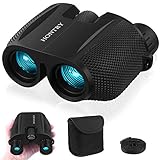
This Hontry pair is the grown-up in the garden. It is designed for adults and children rather than specifically for small hands, which makes it the most broadly shareable option in the group. The supplied details list 10x magnification, Bak-4 prisms, and bright, sharp views in low light.
The palm-sized binoculars weigh 0.6 pounds, and the interpupillary distance adjusts from 60 to 75 millimeters. That fit range may be useful for families who want one pair to pass between an adult and a child instead of carrying separate binoculars.
Why it stands out
- The adjustable spacing is described as fitting children and most adults.
- The 10x25 format and Bak-4 prisms provide a more general-purpose option for family use.
Good to know: This is not a child-specific design. Families should check that the spacing, focusing, and compact body suit the particular child using it.
Best for: Families who want one portable pair that adults and children can share.
#4: The Wooden Beginner Nature Set

This lightweight set is aimed mainly at children ages 4 to 7 and turns one optical tool into a small nature station. Along with the binoculars, it includes a magnifying glass and animal and plant identification cards. That combination lets a child scan for movement at a distance, then drop down into the grass for a closer investigation.
The supplied description identifies the wooden construction as FSC certified, safe, and durable. It is presented for bird watching, hiking, camping, car trips, and general outdoor exploration.
Why it stands out
- The magnifying glass is genuinely useful for switching from distant viewing to close observation.
- Animal and plant cards give adults an easy way to turn backyard wandering into a simple learning activity.
Good to know: The age guidance is inconsistent across the supplied information. The main description centers on ages 4 to 7, while other wording mentions ages 3 to 7.
Best for: Younger explorers who want a playful introduction to both binocular and magnified observation.
#3: The 4x30 Binoculars with a Bird Guide

The LET’S GO! set is ready for a child who likes to arrive properly equipped. It includes 4x30 binoculars, a canvas carrying bag, neck strap, lens cloth, and a bird-watching manual introducing 17 common North American species. The supplied age guidance focuses mainly on children ages 4 to 7.
A non-slip handle is intended to make the binoculars easier for children to grasp. The lower listed magnification and included reference material position this as a friendly beginner package for backyard walks, camping, hiking, and travel.
Why it stands out
- The bird guide gives children 17 recognizable species to search for instead of simply wandering around yelling, “I see something!”
- The bag, strap, and lens cloth make it the most complete carry-ready package in the countdown.
Good to know: The supplied age wording varies from ages 3 to 8, although the main recommendation centers on ages 4 to 7.
Best for: Beginner bird-watchers and families who want useful accessories included from the start.
#2: The Shock-Protected 8x21 Binoculars with Sticker Book

These Noptix 8x21 binoculars bring more optical detail into a distinctly child-sized design. The supplied record describes roof-prism construction, lens coatings, easy focusing and adjustment, soft non-toxic rubber grips, flexible eyecups, and shock protection against drops.
The included sticker book features more than 40 birds, each labeled with its name. That gives a young observer a satisfying way to record discoveries, or at least to apply a triumphant sticker after spotting something vaguely feather-shaped in a tree.
Why it stands out
- The 8x21 format, focusing adjustments, lens coatings, and roof-prism construction give it a stronger optical feature set than the simpler beginner packages.
- Rubber grips, flexible eyecups, and shock protection are practical around enthusiastic small humans.
Good to know: The product is listed for ages 3 and up, but the supplied information does not give a narrower upper age range.
Best for: Young observers who want a more capable child-sized pair plus a bird-identification activity.
And now for the compound-eye crown: our #1 pair does not come with thousands of ommatidia, because apparently nobody at Tasco was willing to manufacture those. It does offer the combination we most want when a child is trying to follow a fast-moving butterfly across the garden.
#1: The Tasco 8x21 Kids’ Field Binoculars

The Tasco 8x21 binoculars earn our top spot because they focus on the practical business of finding and following wildlife. The supplied description emphasizes quick focusing and a large field of view, both valuable when the subject has wings, six legs, no respect for schedules, and absolutely no intention of posing.
They are described as small and lightweight for children ages 3 to 12. Fully coated lenses support viewing, while soft protective rubber around the eyecups and a rubber body coating are intended to help guard against falls and scratches.
Why it earns our top spot
- The large field of view is specifically described as helping children acquire moving critters quickly.
- Quick focusing is useful when a butterfly, bird, or squirrel refuses to remain where it was first spotted.
- The broad listed age range and protective rubber give this pair room to accompany a child through more than one season of exploration.
Good to know: The supplied listing does not identify learning materials or carrying accessories, so this is the field-focused choice rather than the all-in-one activity kit.
Best for: Children who want a compact, protected pair for actively following backyard wildlife.
Final thoughts
The Tasco 8x21 kids’ binoculars are our best overall pick for backyard discovery. Their quick focusing, large field of view, protective rubber, and wide listed age range make them the strongest choice for locating moving wildlife and staying with it. The Noptix pair is the best alternative when a child wants stronger optical features plus a sticker activity, while the wooden beginner set is the most playful choice for combining distance viewing with close-up magnification.
No child needs the compound eyes of a dragonfly to become a sharp naturalist. A decent pair of binoculars, a little patience, and permission to get grass stains on the knees will do beautifully.
Frequently asked questions
Which children’s binoculars include nature-learning materials?
The wooden beginner set includes animal and plant identification cards plus a magnifying glass. The LET’S GO! set includes a guide to 17 common North American birds, while the Noptix pair includes a sticker book featuring more than 40 named birds.
Which pair can children and adults share?
The Hontry 10x25 pair is designed for adults and children, with an adjustable interpupillary distance from 60 to 75 millimeters. Check the fit for the individual child before choosing it as a shared family pair.
Can binoculars be used to watch insects?
Yes, especially for larger or more distant insects such as butterflies, dragonflies, and insects visiting flowers or resting in trees. The supplied listings do not provide close-focus distances, so a magnifying glass remains the better tool for tiny insects at arm’s length.
What is the most important binocular safety rule for children?
Never look at the sun through binoculars. Adults should teach and reinforce this rule before every outdoor viewing session.
Thanks for supporting our mission to make the world a better place for everyone, bugs included.