
September is a glorious time to be a geek. Do you remember enjoying every golden scrap of summer, then feeling an entirely different thrill when school began again? Fresh notebooks. Sharpened pencils. Untouched pages. A new timetable containing the intoxicating possibility that somebody might finally let you into a laboratory.
Only a true geek understands the pleasure of returning to questions. What happens if we change this? Why did that react? Can we measure it? Will it happen again? And, perhaps most important, are the safety goggles available in a less humiliating shape?
These five kits belong to chemistry, physics, and Earth science. Their Bug Zoo connection lives in the habits they teach. Entomologists observe closely, control variables, measure carefully, record everything, and learn to distrust any result that appeared once after somebody bumped the table.
Quick answer
The Earth science exploration kit is our best overall choice for curious geeks because it connects hands-on experiments with the natural world. The 80-experiment laboratory set offers the widest activity range, while the fruit-battery kit gives teachers and homeschoolers one focused electrochemistry project with a satisfyingly visible result.
The back-to-the-lab geek code
A large experiment count looks impressive on a box. Scientific thinking comes from what happens between the instructions and the conclusion. Whatever kit you choose, encourage the resident geek to:
- Ask one clear question. “What happens?” is a beginning. “Does changing the amount of water alter the result?” can become an experiment.
- Change one variable at a time. Changing everything creates excitement, mess, and very little usable information.
- Write it down. Dates, quantities, observations, mistakes, and unexpected results all belong in the record.
- Repeat the experiment. One dramatic result may be discovery, coincidence, contamination, or somebody leaning on the table.
- Read the instructions before opening mysterious packets. Even brilliant people benefit from knowing where the gloves are.
Teachers and homeschoolers can extend nearly any kit by asking students to predict the outcome first, draw the setup, compare repeated trials, and explain what the evidence actually supports. Those four additions turn an activity into science.
How we chose
We compared the five kits by activity range, scientific field, included tools, instruction style, age guidance, household-material requirements, supervision notes, and usefulness in classrooms or home learning. These are general science kits, so we have stopped pretending that a volcano develops an insect connection simply because somebody placed a beetle nearby.
Product details, availability, and shipping restrictions can change. Confirm current contents, specifications, age guidance, and requirements with the retailer before purchase. Adult supervision should reflect the learner, materials, and experiment.
Reviewed by Carol Maier, B.Sc., professional entomologist and founder of the original Victoria Bug Zoo.
Affiliate disclosure: As an Amazon Associate I earn from qualifying purchases. This article contains affiliate links. If you make a purchase through one of these links, Bug Zoo® may earn a commission at no additional cost to you.
#5: Broad Chemistry Kit with 40-Plus Experiments

This broad chemistry and STEM set lists more than 40 experiments, including bouncy-ball and lava-lamp activities. Its manual uses step-by-step directions and friendly illustrations, while the product information describes most materials as included apart from some common household additions.
Why it stands out
- More than 40 activities provide plenty of repeat visits to the experiment table.
- The illustrated manual supports learners who prefer visual instructions.
Good to know: Some activities require household items, so inspect the instructions before announcing that the laboratory is open.
Best for: Geeks who want a varied chemistry set for weekend projects, activity rotations, or rainy afternoons.
#4: Junior Chemistry Laboratory with 50 Experiments

The National Geographic junior chemistry set offers 50 hands-on experiments and more than 20 kid-friendly laboratory tools. Some activities use familiar materials such as baking soda and vinegar. Illustrated instructions break each experiment into steps, making this the most approachable chemistry introduction in the roundup.
Why it stands out
- Fifty experiments offer more range than a single-project kit.
- More than 20 tools help the setup feel like a small laboratory rather than a worksheet with vinegar on it.
Good to know: The supplied information describes the set for ages four and up, although reading ability, materials, and experiment complexity still determine how much supervision makes sense. Some household supplies are required.
Best for: Newer geeks who benefit from illustrated guidance and a generous selection of laboratory tools.
#3: Build-Your-Own Fruit Battery Laboratory
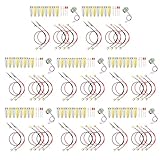
This focused project supplies copper and zinc sheets, wires, clips, LEDs, and an electronic clock for building simple batteries with fruit, vegetables, drinks, or salt solutions. Zinc releases electrons, the liquid provides an electrolyte, and the circuit carries electrical energy to a small device. Suddenly the potato has a job.
Why it stands out
- One defined project makes prediction, comparison, and repeated trials easy to organize.
- Different fruits or solutions allow learners to compare materials while keeping the basic circuit similar.
Good to know: LED polarity matters, and the supplied information calls for teacher or parent supervision for anyone younger than fourteen.
Best for: Teachers, homeschoolers, and independent geeks who want a focused electrochemistry demonstration with a visible outcome.
#2: The 80-Experiment Home Laboratory

This is the maximalist option: 80 laboratory-style experiments ranging from rainbow rain and fountains to volcanoes and bottle-blown balloons. Guidance cards describe the procedures and scientific ideas. The listed equipment includes goggles, gloves, petri dishes, test tubes, droppers, measuring cups, measuring spoons, balloons, pigments, and other components.
Why it stands out
- Eighty activities make it the broadest experiment collection in the roundup.
- The substantial tool selection supports repeated laboratory sessions.
Good to know: The supplied guidance is for ages six and older. The kit contains chemical materials that should be sealed properly after use, and a large activity count still requires time to read and prepare each procedure.
Best for: Classrooms, families, clubs, and committed geeks who want a laboratory collection rather than one afternoon’s demonstration.
#1: Earth Science Exploration Laboratory

The National Geographic Earth science kit takes first place because it brings the laboratory back to the planet beneath our feet. The listed activities include water tornadoes, an erupting volcano, crystal growing, and two geological dig kits. A full-color learning guide explains the science behind the projects, and the format works well for a family table, classroom group, or homeschool unit.
Why it wins
- The activities connect several Earth science ideas through water, minerals, volcanoes, and geological investigation.
- The learning guide supports discussion of the underlying science after the exciting part has stopped fizzing.
Good to know: The supplied age guidance is eight to twelve. Older geeks may still enjoy the projects, although they may insist they are supervising.
Best for: Curious minds drawn to nature, geology, weather, ecosystems, and the physical world that every living thing depends upon.
Final thoughts
The Earth science laboratory earns first place for connecting experiments to the larger natural world. Choose the 80-experiment set when breadth matters most, the fruit battery for a focused classroom demonstration, and either chemistry collection according to experience level and preferred activity count.
September still belongs to anyone who feels a tiny surge of optimism at the sight of a blank notebook. Pull on the goggles, sharpen the pencil, and go ask an inconveniently specific question.
Thanks for supporting our mission to make the world a better place for everyone, bugs included.
Frequently asked questions
Are these science kits only for kids?
No. The manufacturers provide age guidance, but teachers, homeschoolers, families, clubs, and grown-up science geeks can use the projects according to their interests and experience.
Which kit has the most experiments?
The 80-experiment home laboratory lists the largest included activity count in this roundup. The two chemistry sets offer 50 and more than 40 experiments.
Which kit is best for a classroom demonstration?
The fruit-battery kit offers one focused project with components for repeated comparisons. The Earth science and larger laboratory kits provide more activities for a longer unit or rotation.
What makes a science activity into an experiment?
A clear question, a controlled variable, recorded observations, and repeated trials give the activity an experimental structure. Asking learners to predict and explain results adds another valuable layer.