

At university I once looked through a stereoscope at what appeared to be a rather disappointing pile of sweep-net debris. I could have tipped the whole business into the bin without a pang. Through the lenses, though, the bits of debris had legs. There were tiny insects in colors I hadn’t expected, with shapes so peculiar that I had to lift my head and check that I was still looking at the same pile. I would dearly love to give a child that moment for Christmas.
A fallen fir needle is a perfectly respectable place to begin. Turn it over under a little digital microscope and see how different the underside looks. If something on the branch gets up and walks away, so much the better. A real Christmas tree occasionally comes with a conifer aphid, a small sap-feeding insect with no interest whatsoever in your gingerbread. A child who finds one has a question worth investigating before anybody reaches for the vacuum.
Clicking an affiliate link is free. If you buy through one, Bug Zoo® may earn a commission at no extra cost to you. As an Amazon Associate I earn from qualifying purchases.
Which microscope would I put under the tree?
When I compare these five gift sets, I give more weight to a steady view and something interesting to look at than to the biggest number printed on the box. Enlarging a blurry picture just gives you a larger blur. These are my picks from the listed features; I haven’t tested these five models side by side. If your children will share one, go straight to #3. If this is somebody’s very first microscope, my pick is #1.
#5: Pocket microscope camera

The child who takes photographs of absolutely everything has a reasonable case for the Trigowalt. It switches between ordinary photos and close-ups, so a child can photograph the whole branch before zooming in on the odd little bump that started the investigation. I put it fifth because saving that pair of pictures depends on a storage card. Check the contents of the particular kit before you wrap it.
See the pocket camera on Amazon
#4: Tabletop scope with a folding stand

Try holding a lens over the tip of a needle with one hand while pointing out a detail to somebody with the other. You soon appreciate a stand. The BAIJLE has a folding one and a case, a sensible combination for a kitchen table that has to turn back into a kitchen table by supper. Its two-inch screen is small for sharing, though, and the card for extra storage is sold separately.
See the folding stand and case
#3: Four-inch screen for siblings
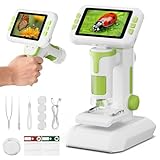
If two children are opening one present between them, this is the one I would choose. The HEWEIMEI has a four-inch screen, big enough for one child to point out a detail while the other still has a chance of seeing it. The scope lifts off its stand when someone spots a more interesting subject across the room. It earns third place overall, but it solves the “let me see!” problem better than the two-inch models.
See the larger-screen microscope
#2: Pocket scope for a young photographer

For a child who insists on showing Grandma exactly what she missed, I like the Mefhinrix. The included 32 GB card takes care of saving pictures, and the scope can share a live view with a compatible computer. Focusing it by hand takes a little practice. That becomes part of the fun once a child discovers that the top of a beetle and the table beneath its feet come into focus at different points.
See the scope with the included memory card
#1: First microscope with prepared slides

The BEBANG gets my vote for a first Christmas microscope because it answers the question that follows the unwrapping: “Mom, what can I look at?” There are five prepared glass slides in the kit, a slot to hold one steady, and a 32 GB card to save that first good picture. The fitted case gives the slides somewhere to live when the dining table is called back into service. I would charge it before wrapping and help a younger child with the glass. Of these five, it asks the least of the grown-up on Christmas morning.
See the five-slide starter kit on Amazon
My Christmas-morning mystery slide
Before the wrapping paper goes in the recycling, snip a piece of woven ribbon and put it beside a fallen needle on white paper. Ask your child to take one close-up of each while you look away. Can you tell which picture came from the tree and which came from the present? Look for threads crossing over and under one another in the ribbon. Then let your child choose the next mystery object. A corner of Grandpa’s Christmas sweater is fair game, provided Grandpa is still in it and no scissors are involved.
What would I wrap with it?
For the child who asks what everything is called, I’d add National Geographic Kids’ Ultimate Bugopedia. The photographs give a seven- to ten-year-old somewhere to go with the next question. For the child who would rather draw what she sees, Julia Rothman’s Nature Anatomy Notebook has room for sketches and a lesson in drawing a dragonfly. I’d pick whichever sounds more like your child. The back of an envelope also makes a fine field notebook if the microscope has already claimed the Christmas budget.
What can a homeschool group look at in January?
I’d try the Roly-Poly Pill Bugs Kit from Carolina Biological Supply Company. It includes living pill bugs and sow bugs, so arrange delivery for the week you’ll use it. Both are little land-dwelling crustaceans. Give the children time to watch them walk around the terrarium and see whether they can tell a pill bug from a sow bug. An animal that can walk out of focus has quite a bit to teach a young photographer.
For Christmas morning itself, I’d put the five-slide kit under the tree and leave a little square of white paper beside it. One day your child may look at something you are about to sweep up and say, “Wait, Mom. I think that’s a leg.” I’d count that as a very good return on a Christmas present.
Curious about a visitor on your tree? Penn State Extension has an illustrated guide to insects found on real Christmas trees.
By Carol Maier, B.Sc., professional entomologist and founder of the original Bug Zoo® in 1997.
Thanks for supporting my mission to make the world a better place for everyone, bugs included.
BUG ZOO® is a registered trademark founded by Carol Wynn Maier in 1997. Use of BUG ZOO® as a brand or business name without authorization is prohibited.