
A beetle that looks like a black speck from three feet away may turn out to be blue, green and burnished copper when you get close enough. Wing veins, antenna joints, scales and tiny hairs are easy to miss with an ordinary photograph. A useful macro attachment brings those details into view without requiring every curious naturalist to buy a completely new camera system.
The five choices below work in different ways. One clips onto a smartphone, three screw onto compatible camera lenses like filters, and one combines a detachable macro attachment with a wide-angle lens. The most important specification is not the camera brand printed on the box. It is the phone-clamp requirement or the filter-thread diameter marked on the front of your lens.
Quick answer
Phone photographers should look for a secure clamp, a practical working distance and a lens that suits their particular camera layout. Camera users must match the attachment to the lens thread, usually shown beside the diameter symbol on the lens barrel or beneath the cap. The countdown builds from specialized filter sizes to the option that offers the easiest entry into serious insect close-ups.
How we chose
These are editorial picks based on documented magnification, optical construction, compatibility, included components and usefulness for insect photography. The order reflects accessibility and versatility, not verified sales popularity. Close-up filters can be an affordable way to experiment, although they do not behave exactly like a dedicated macro lens.
Product details, availability and compatibility can change. Confirm the current specifications and the thread size of your own lens before purchasing.
Reviewed by Carol Maier, B.Sc., professional entomologist and founder of the original Victoria Bug Zoo.
Affiliate disclosure: Clicking an affiliate link is free. If you make a purchase through one of these links, Bug Zoo® may earn a commission at no additional cost to you. As an Amazon Associate I earn from qualifying purchases.
#5: Four-Strength Close-Up Filter Set for 77 mm Lenses

This set includes +1, +2, +4 and +10 diopter filters for compatible 77 mm lenses. Different strengths let a photographer experiment with working distance and magnification while using an existing lens. The filters are made with optical glass, can be stacked through their double-threaded design, and come with a water-resistant nylon pouch.
Why it stands out
- Four diopter strengths provide several levels of close-up assistance.
- The filters can be combined for additional experimentation.
Good to know: This is the most specialized fit in our countdown. The product record names selected Canon cameras paired with a compatible 77 mm lens, but the lens-thread diameter is the deciding measurement.
Best for: Canon photographers who already own a compatible 77 mm lens and want an inexpensive way to explore insect detail.
#4: Four-Strength Close-Up Filter Set for 40.5 mm Lenses

The 40.5 mm version supplies the same +1, +2, +4 and +10 diopter range for compatible Sony lenses. It gives photographers several ways to shorten the focusing distance when photographing beetles, spiders, flowers and other small subjects. Optical glass, double threading and a water-resistant storage pouch round out the set.
Why it stands out
- The four strengths can be used individually or combined.
- Its compact thread size fits several of the Sony lens combinations named in the listing.
Good to know: Camera-body compatibility lists are only a starting point. Verify that the actual lens has a 40.5 mm thread before ordering.
Best for: Sony camera users who want several close-up strengths without replacing a compatible kit lens.
#3: Four-Strength Close-Up Filter Set for 49 mm Lenses
This 49 mm set is listed for several Canon lens combinations and includes +1, +2, +4 and +10 diopter filters. It offers a straightforward way to test different close-up effects using compatible 15 to 45 mm and 18 to 45 mm lenses. The filters use optical glass, stack through double threading, and travel in an included nylon pouch.
Why it stands out
- Four strengths make it easier to test how much close-up power a subject needs.
- The 49 mm size suits several common Canon kit-lens combinations named in the listing.
Good to know: A camera model may accept many different lenses. Check the diameter marking on the lens itself rather than relying on the camera name.
Best for: Canon photographers with a compatible 49 mm lens who want a flexible first step into close-up work.
#2: Detachable Macro and Wide-Angle Attachment for 58 mm Lenses

This attachment earns second place because it handles two very different jobs. The detachable macro component is intended for high-resolution close-ups of small subjects, while the wide-angle component expands the field of view. The listing names compatible 58 mm lenses from Canon, Nikon, Olympus, Panasonic, Fujifilm and other manufacturers.
Why it stands out
- The detachable macro component is purpose-built for small-subject photography.
- The accompanying wide-angle function gives the attachment a useful second life beyond bugs.
Good to know: The broad brand list does not make the attachment universal. It requires a compatible 58 mm lens thread.
Best for: Camera owners who want both insect close-ups and a wider field of view from one attachment.
#1: 15X Clip-On Macro Lens for Smartphones
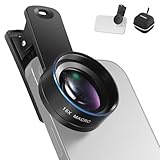
The 15X smartphone lens is our top pick because the best insect camera is often the one already in your pocket. Its stated working distance of 0.8 to 1.6 inches suits small subjects that will remain still long enough for a careful photograph. The lens uses HD optical glass in a two-element, two-group design, while coatings are intended to resist water, fingerprints and scratches. A 37 mm clamp and cleaning cloth are included.
Why it is our top pick
- It brings strong stated magnification to a device many people already carry.
- The short working distance encourages deliberate observation of fine insect structures.
Good to know: Results and vignetting can vary with phone-camera layout. The supplied guidance recommends cleaning the phone camera, tightening the lens, disabling the phone's automatic macro mode if necessary, and trying 1.1X zoom or higher when dark corners appear.
Best for: Curious naturalists, families and field observers who want an accessible route into detailed insect photography.
Final thoughts
The 15X smartphone lens is our best overall choice for most people because it makes serious close-up experimentation possible without carrying a separate camera. The detachable 58 mm attachment is the strongest camera option for photographers who will use both its macro and wide-angle functions. The three filter sets remain sensible choices when their thread sizes match equipment you already own.
Whichever tool you use, approach a living insect slowly, avoid trapping it against a surface, and let it leave when it has had enough of being famous. The most revealing photographs usually begin with patient observation.
Thanks for supporting our mission to make the world a better place for everyone, bugs included.
Frequently asked questions
Is a close-up filter the same as a dedicated macro lens?
No. A close-up filter acts more like a magnifying glass attached to an existing lens. It can shorten the focusing distance and reveal more detail, but image quality, working distance and magnification will differ from a dedicated macro lens.
How do I find my camera lens thread size?
Look for the diameter symbol followed by a number on the front of the lens, around the barrel or beneath the lens cap. Match that number exactly to the attachment size.
Can a smartphone macro lens photograph live insects?
Yes, particularly slow-moving insects that tolerate a close approach. Use natural light when possible, brace the phone, focus on the eyes or another prominent structure, and avoid handling the animal merely to force a photograph.